Blueprints.René van Kuyk
← Back to selected work
Banking · Claims

Funeral claims.

Making the funeral claims journey easier to follow at a difficult time.

Company
Capitec Bank
Period
June–July 2025
Design tools
Figma
The brief

A broad ambition. A short runway.

I started the project in early June 2025 with a brief to bring both funeral and life-cover claims into the Capitec app. The deadline was the end of July. I reviewed the existing claim journeys across the bank and worked closely with the product business analyst to understand the scope and dependencies.

The full brief was too large for the available time. Together, we narrowed the MVP to funeral claims submitted by policyholders, a scope decision recorded on 17 June 2025. The work that follows focuses on that funeral-claims journey.

Early JuneProject begins
17 JuneMVP scope agreed
Startled cat expressing deadline anxietyEnd JulyDelivery deadline
Inherited complexity

Understanding what was already there.

Problem 1: Recovering the original designs.

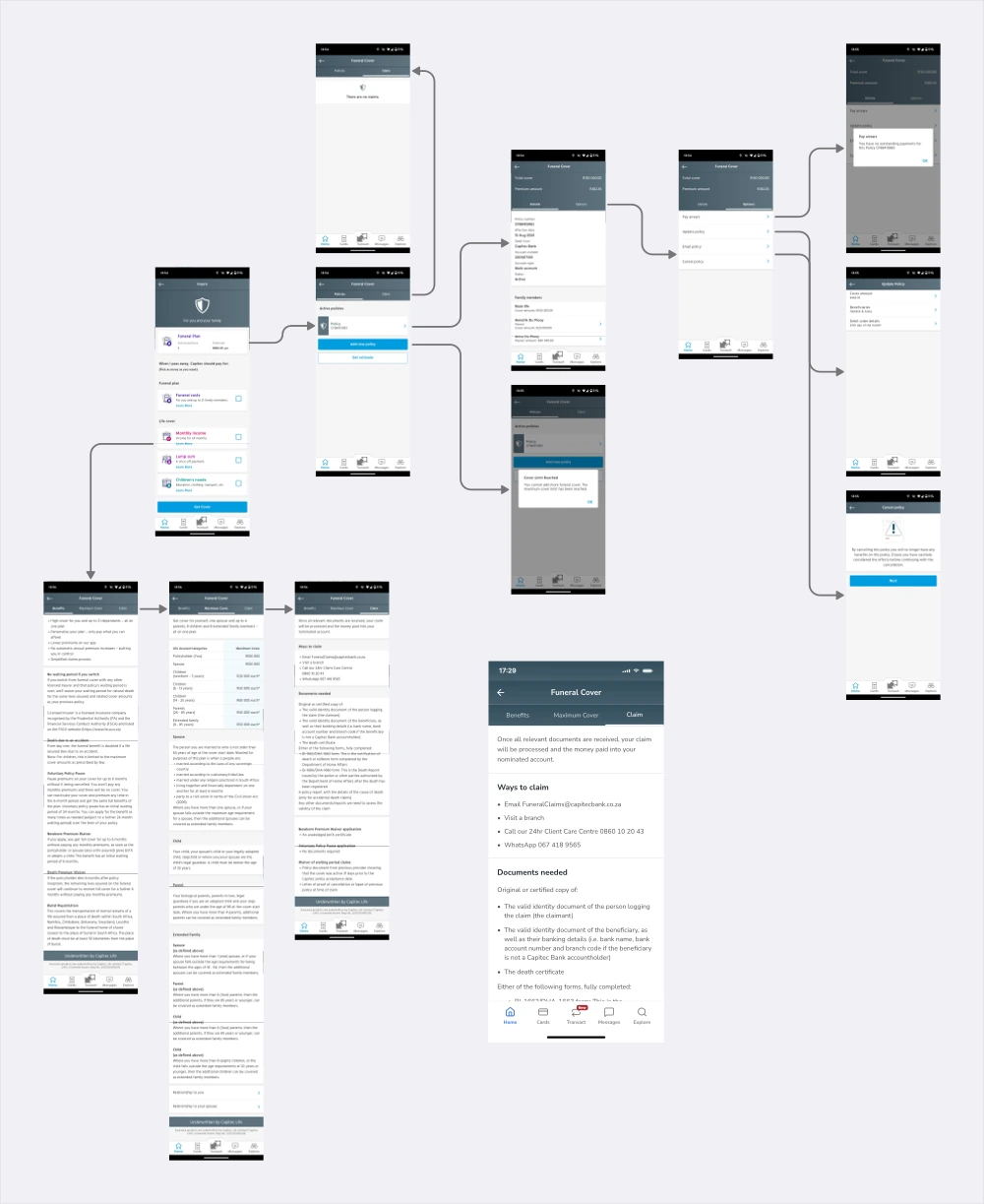
The insurance experience had previously been outsourced to a third-party team. Its interface differed significantly from the bank’s other products, and we initially had no access to the original design files. A developer still working with the team eventually helped us recover them.

Problem 2: Understanding historical records.

Following the move to in-house insurance in December 2024, historical records still reflected data from the previous insurance partner. We needed suitable test accounts containing those records to understand what clients would see and which information the new journey needed to display.

Research context · June–July 2025

Where the process was letting people down.

Agent conversations highlighted manual communications and clients’ frustration with the time taken to complete a claim. SMS updates depended on an agent remembering to send them. Investigations could extend the wait, particularly when documents were incorrect or flagged as potentially fraudulent.

±10,000claims per day
Figure supplied during the project
33.50%Successful claims within 24 hours
40.80%Successful claims within 48 hours

These were the measures of success we were given for the existing process, not results of my design.

Existing claim channels

Several routes. One need for clarity.

Across the broader insurance service, clients could contact the bank through WhatsApp, email or a branch. For funeral claims, email was the main route recorded in my research. A branch agent would submit an email on the client’s behalf.

Client communication
Responses generally followed the channel where the claim began.
Internal death-record checks
An internal process, known as “death wash”, checked ID numbers against Department of Home Affairs records. A deceased match could automatically trigger the claim process.
Incomplete claims
Claims without the necessary documents or client feedback were automatically closed after 90 days.
The central constraint

Documents arrive in stages.

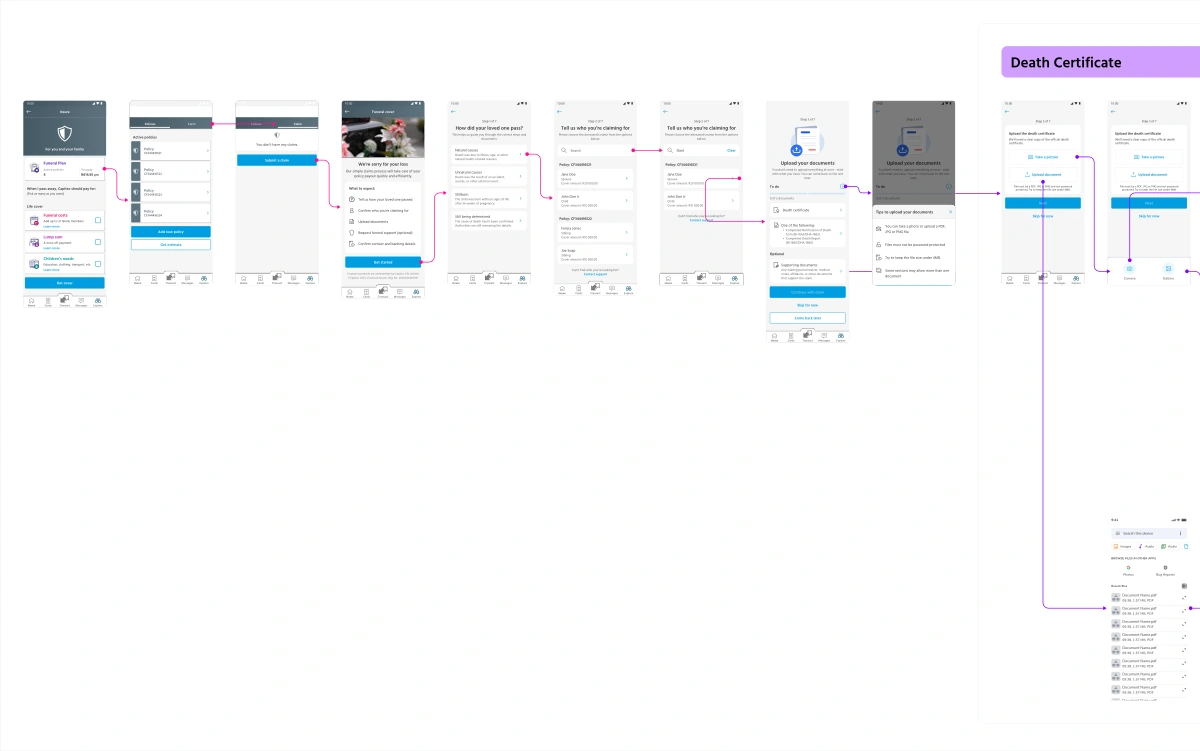
The app could not upload documents. That was a major gap for a claims journey, and my designs proposed how it could work. Clients also collected paperwork from different places, so they needed to submit what they had, see what was missing and come back later.

Natural death
  • Death certificate
  • BI-1663 document

Claimant’s ID also required when the claimant was not the policyholder.

Unnatural death
  • Death certificate
  • BI-1663 document
  • Police report

Claimant’s ID also required when the claimant was not the policyholder.

Waiting-period evidence
Natural-death cover had a six-month waiting period. Evidence of qualifying previous funeral cover could support a waiver, and could still be supplied at claim stage.
Date of death and cover status
The research highlighted that a claim could remain eligible after cancellation or lapse if the death occurred while cover was active and premiums were up to date.

Partial settlement using the documents already received was also raised with the BA for further review.

Product rules · Research snapshot

The rules behind the screens.

These are the funeral-product rules captured during the project. They shaped the information, choices and exceptions the journey needed to handle.

Policies and people
A client could hold multiple policies covering different people. The journey needed to help them identify the right policy and the person they were claiming for.
Benefits and exceptions
Stillborn cover, policy pauses, newborn premium waivers and funeral support services introduced different eligibility rules and supporting information.

These notes describe the product at the time of the project and are not a guide to its current terms.

A human perspective

Designing for a mind full of fog.

I had not experienced the loss of a parent or someone close to me, so I needed to listen carefully rather than assume I understood what making a claim would feel like. A dear friend shared how she felt after losing her father.

“My mind was fuzzy, like it was filled with fog. I could not think straight. Don’t ask me about numbers or paperwork.”

This informal conversation helped me reconsider the tone of voice, the structure of the questions and how easily someone could navigate the flow while grieving.

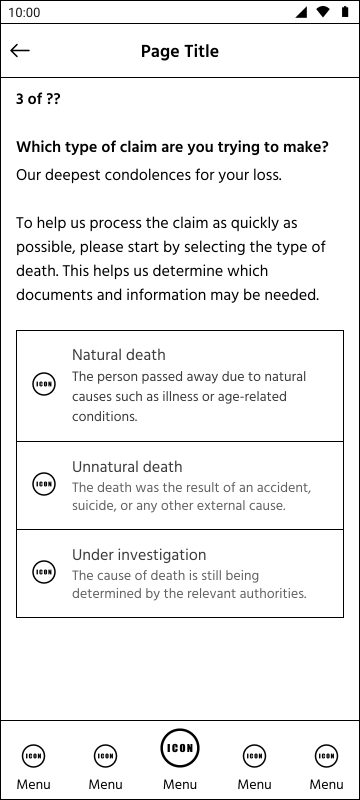
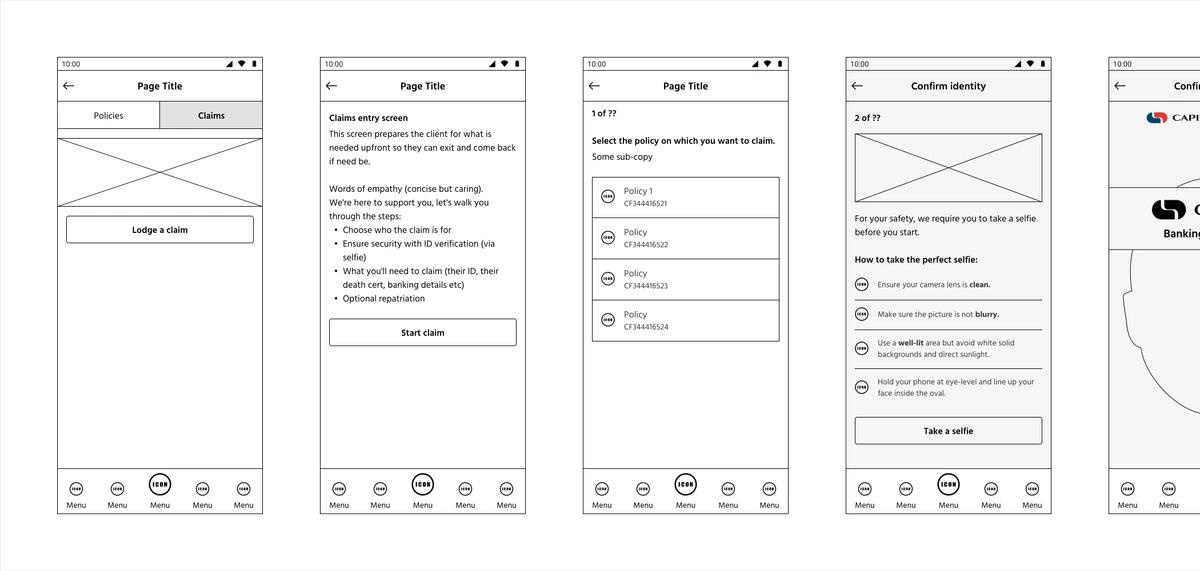
The early wireframe

“Which type of claim are you trying to make?”

“To help us process the claim as quickly as possible, please start by selecting the type of death. This helps us determine which documents and information may be needed.”

The shift in approach

Reduce what we ask of someone who is grieving.

I began designing around the thought: “I don’t have the mental capacity to help you.” The question for us became: how easy and painless can we make this?

That guided simpler questions, a more considerate tone and a flow with clear next steps.

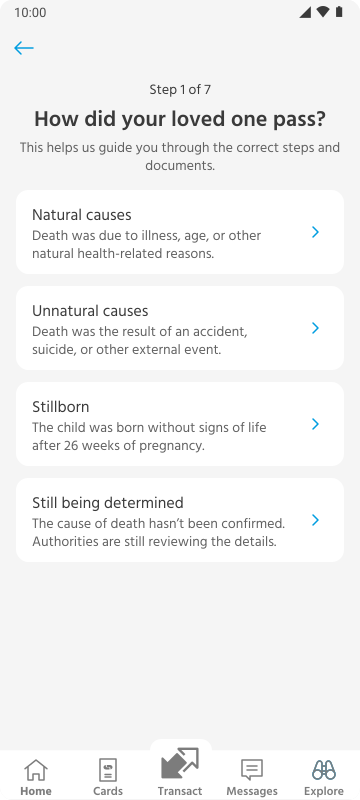
Here is what changed: a shorter, more personal question, with less work for the person grieving.

Before · Early wireframe
Early wireframe asking which type of claim the client is trying to make
A broad claim-type question, followed by a lengthy explanation centred on processing the claim.
After · Final design
Final design asking How did your loved one pass, with a shorter explanation and Step 1 of 7
“How did your loved one pass?” A shorter explanation, clear progress and options that retain the required distinctions.
Design priorities

Make the next step understandable.

Keep clients informed
Explore in-app communication and make important information or required action easy to notice. A key research question was whether clients would read those messages.
Explain progress
Use clear feedback and timelines to help clients understand the claim’s status, including investigation-related delays.
Support incomplete documentation
Explain what has been received, what is missing and how to continue with the proposed upload capability dependent on development.
Close the feedback loop
Make the 90-day auto-close process understandable, including what clients need to do before that point.
Keep the MVP focused
Allow policyholders to submit funeral claims. Supporting benefit information, sending documents to clients and downloadable claim paperwork were also considered during prioritisation.
Questions raised with the BA

Designing around trust and exceptions.

I flagged these gaps with the BA so we could understand the checks needed. They were questions to investigate, not confirmed fraud incidents.

Partial settlement
What checks were needed before a portion of a claim could be finalised using incomplete documentation?
Relationship validation
How should eligibility be established when extended-family relationships were not validated in the existing process?
Claim initiation
What verification was needed when someone could start a claim using an ID or policy number?
Benefit eligibility
What checks applied to funeral support services when the underlying claim had not yet been approved?
My contribution and handover

From operational detail to an app journey.

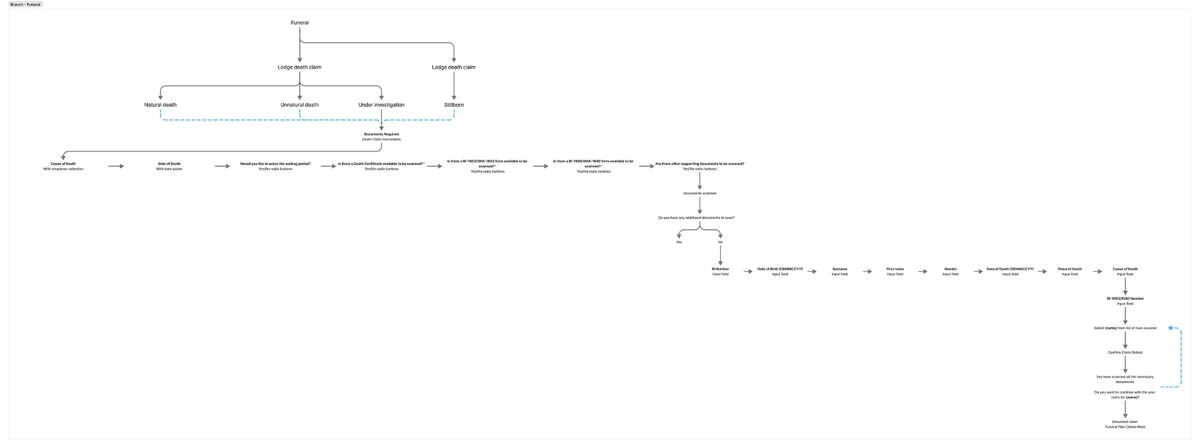
I researched the existing channels and claim processes, worked with the BA to define a manageable scope, and translated the findings into the UX flow and screen designs. The interface used the bank’s previous design system, before Paragon, so I worked within its established components and constraints.

The project was reassigned to another designer before I could take it through the final stages. The feature had not launched as of October 2026.

Project material

The work, in pictures.

Explore the existing insurance interface, the branch and WhatsApp journeys I mapped, my first low fidelity wireframes and the final happy flow.

Original project artefacts may refer to me by my maiden name, René du Plooy.

Prototype

Following the claim journey.

A walkthrough of the designed happy flow. This demonstrates the proposed experience, rather than a live feature in the app.

1 min 52 sec · Prototype walkthrough

Reflection

Every question carries weight.

In February 2026, news reports described a family bringing their deceased relative’s body to a Capitec branch amid a funeral-claim dispute. Reading about it was deeply upsetting, especially knowing that the app journey I had designed had not yet reached clients. I cannot know whether it would have changed that family’s experience, but it reinforced why clearer, more accessible claim journeys matter.

I learned how many steps sit behind a claim. Documents, decisions, exceptions and follow-ups, all while someone may barely have the capacity to think. Making it easier meant looking at the process, not just the screens.

I have a lot of respect for the people doing this work every day. Even the simplest wording can land badly. Dark humour helped me through the difficult parts of the project. The experience itself needed care and clarity.

My strongest learning was to ask less of the person grieving, and more of the experience we were designing for them.

News context · February 2026 ↗